
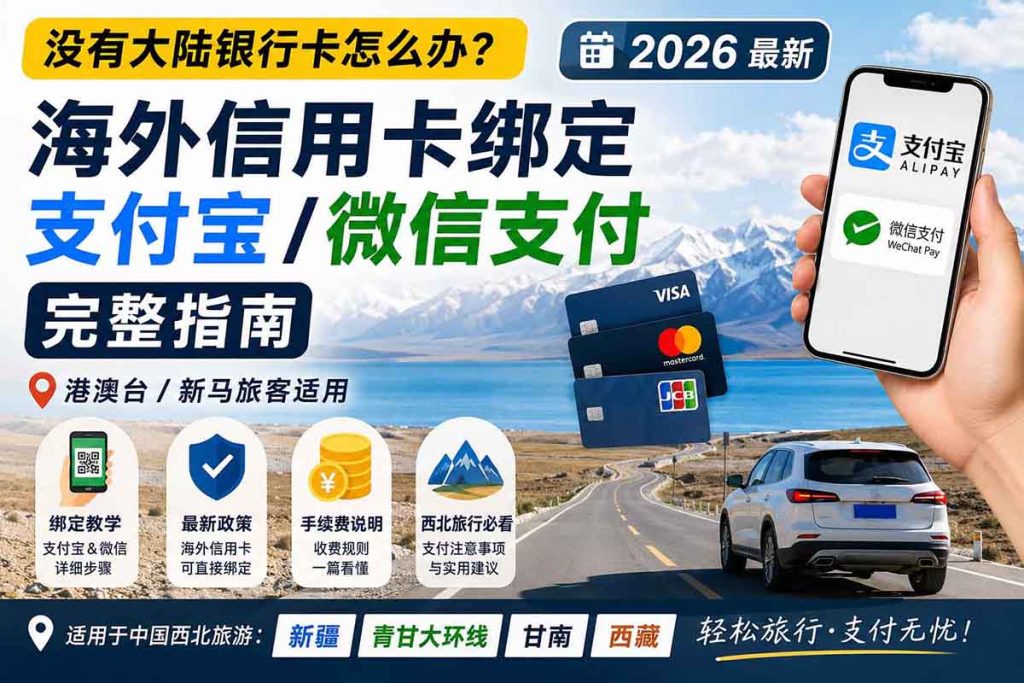
Overseas travelers preparing to visit China, especially those visiting Xinjiang, Qinghai-Gansu Grand Loop, Gannan, Tibet, and other northwestern regions of China or other inland areas for the first time, almost all encounter the same question:
「Can I pay in China without a mainland bank card?」
「Do Alipay and WeChat Pay require a Chinese phone number?」
「Can Visa and Mastercard be bound directly?」
If you are from Hong Kong, Macau, Taiwan, Singapore, Malaysia, or other overseas countries, you really don’t need to worry too much.
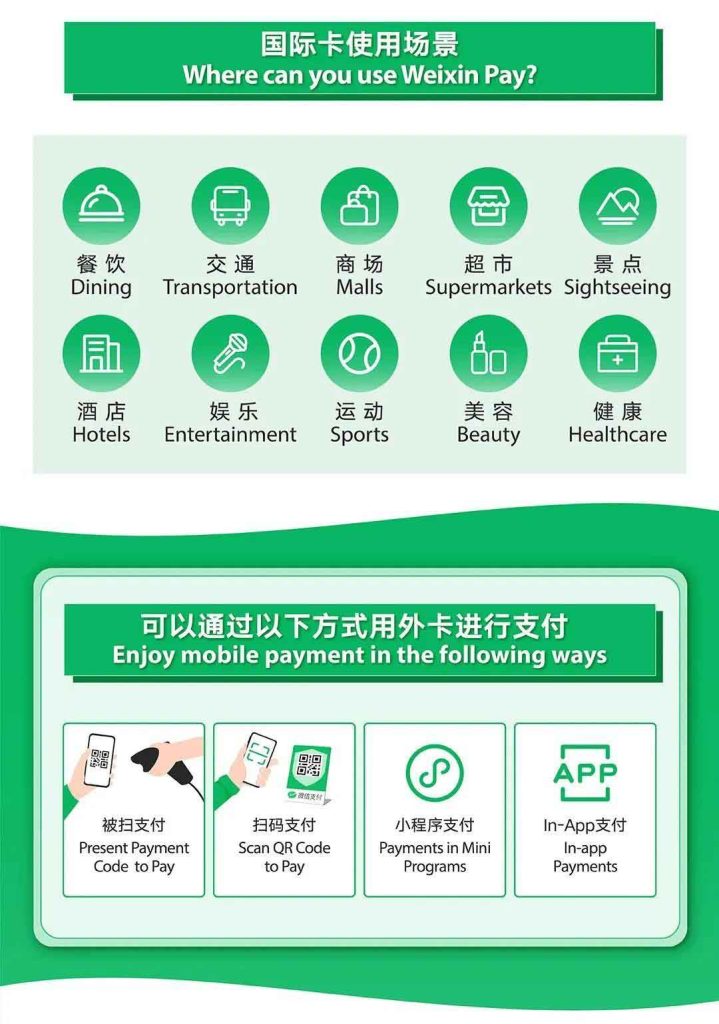
In recent years, China has continuously optimized the payment experience for overseas travelers. Currently, most overseas travelers can directly bind international credit cards such as Visa, Mastercard, JCB to Alipay or WeChat Pay without needing to open a mainland Chinese bank account, and can use electronic payments in most restaurants, scenic spots, convenience stores, hotels, taxis, and other scenarios.
If you are planning to visit Xinjiang, the Qinghai-Gansu Grand Loop, Gannan, or other parts of China, this article will help you understand the latest payment methods and a few payment details that are easily overlooked during travel in China.
1、Can I travel in China without a mainland bank card?
The answer is: Yes, and it’s much more convenient than before.
Currently, most overseas travelers can use the following that meet the payment platform’s support conditions:
- Visa
- Mastercard
- JCB
Direct binding:
- Alipay
- WeChat Pay (WeChat Pay)
Daily consumption is basically no problem, for example:
- Scenic spot tickets
- High-speed rail tickets
- Restaurants
- Coffee shops
- Supermarkets
- Convenience stores
- Taxis
- Most hotels
Based on years of experience receiving overseas tourists traveling through Xinjiang, the Qinghai-Gansu Grand Loop, Gannan, and Tibet: In core tourist cities in the northwest and Tibetan areas such as Urumqi, Yining, Kashgar, Xining, Zhangye, Jiayuguan, Dunhuang, and Lhasa, mobile payment adoption is already very high; commercial facilities in central and coastal cities in China (Beijing, Shanghai, Hangzhou, Xi’an, Guilin, Changsha, Zhangjiajie, Guangzhou, Shenzhen) are more complete and developed, and payment convenience goes without saying. Overall, making payments during travel is very convenient.
However, please note:
Some merchants use personal payment QR codes (such as the boss’s own WeChat or Alipay QR code), and wallets bound to overseas credit cards may sometimes fail to complete payment. In this case, you can switch to cash payment or ask the merchant if they have a company merchant payment QR code.
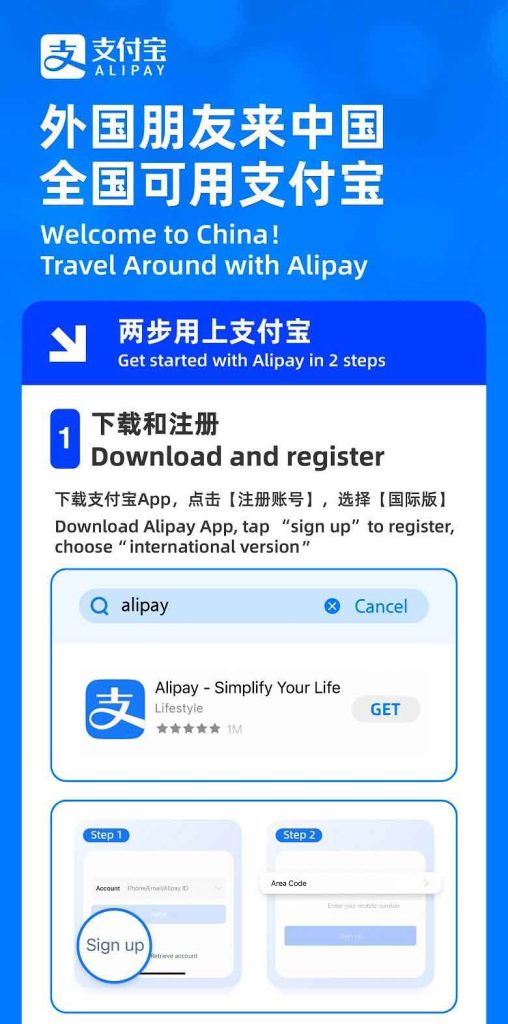
2、How to bind Alipay?
The entire process takes only a few minutes.
Step 1: Download the Alipay App
You can register an account using an overseas phone number.
Step 2: Complete identity verification
Go to:
Me → Identity Verification
Upload your ID as prompted by the system, for example:
- Mainland Travel Permit for Hong Kong and Macao Residents
- Taiwan Compatriot Permit
- Passport
Complete identity verification.
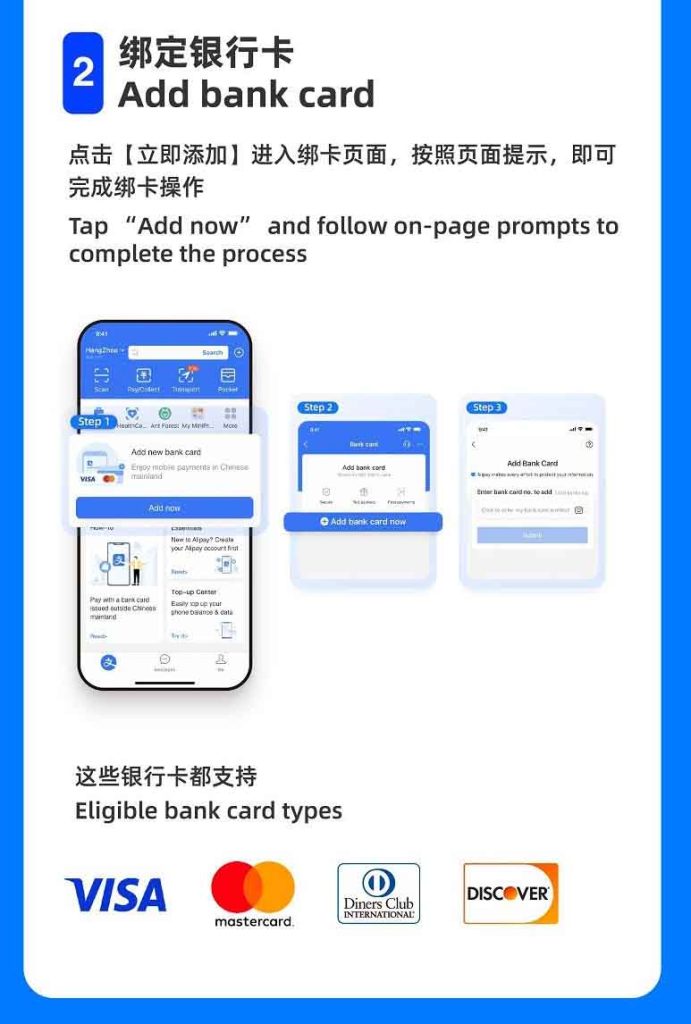
Step 3: Bind overseas credit card
Go to:
Me → Bank Cards → Add Bank Card
Fill in:
- Credit card number
- Expiry date
- CVV security code
- Mobile verification code
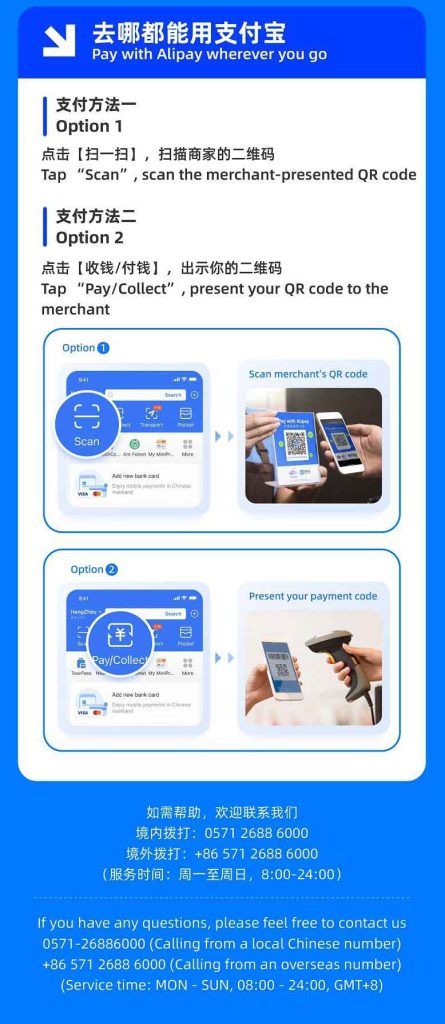
You can start using it after completion.
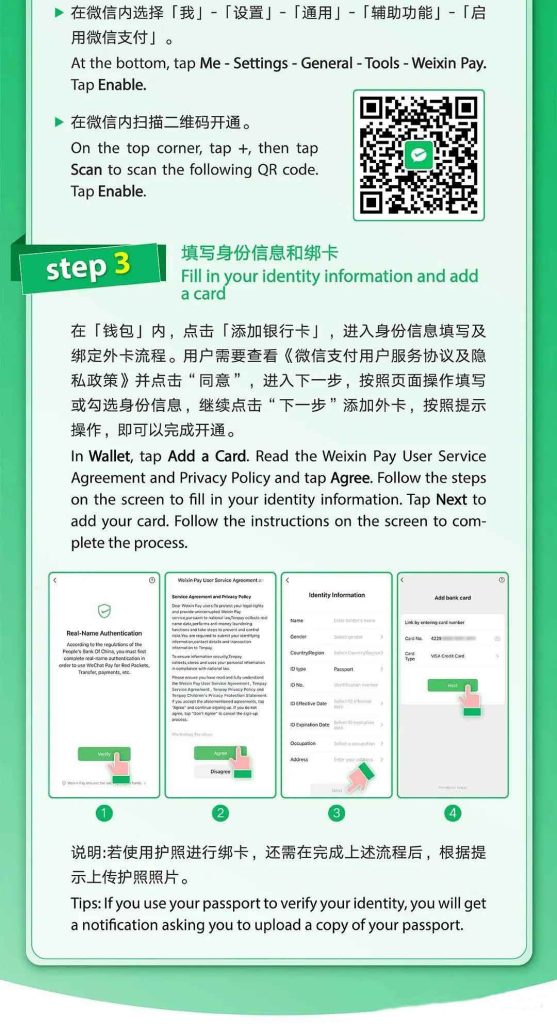
3、Can WeChat Pay bind overseas credit cards?
Yes.
Open:
Me → Services → Wallet → Bank Cards
Complete as prompted by the system:
- Identity verification
- Add overseas credit card
- Mobile verification
Binding is complete.
If you already use WeChat to contact friends and family, it is also recommended to bind WeChat Pay at the same time for greater convenience during your trip.

4、Bank card payment and cash exchange
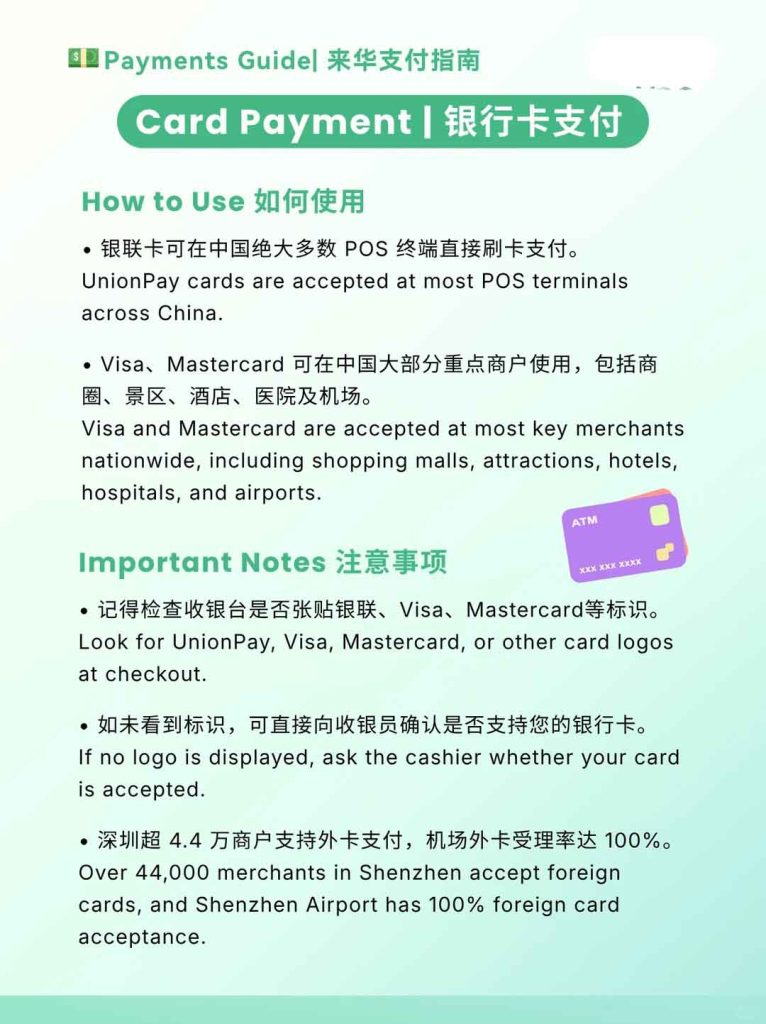
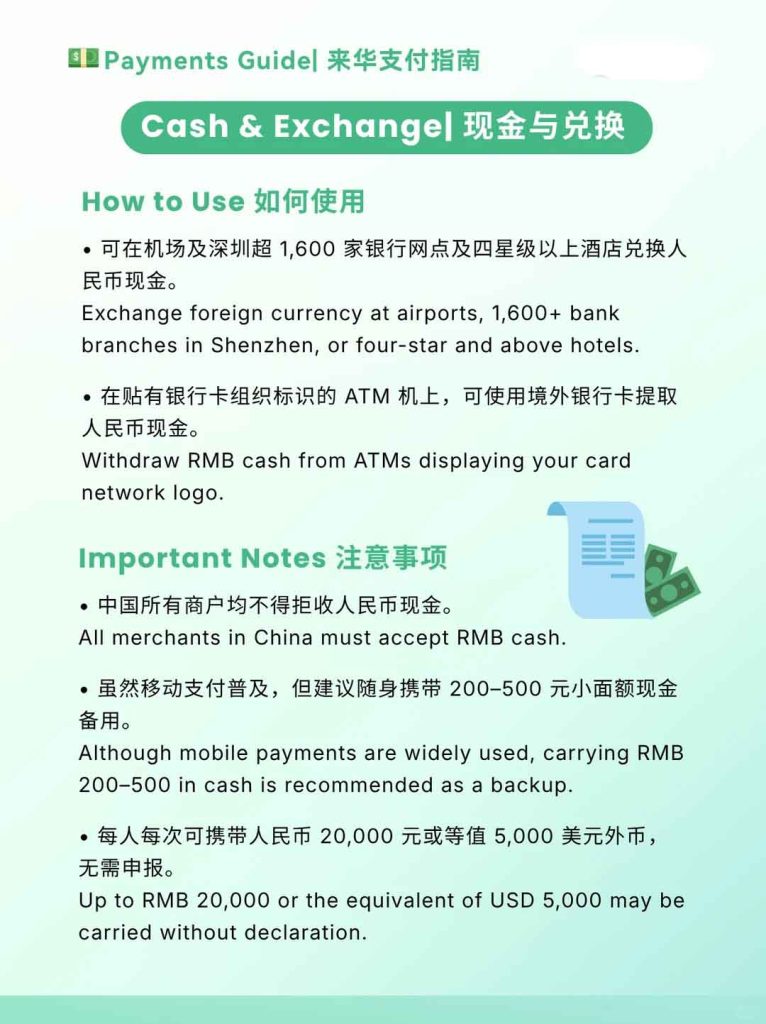
High-end hotels, large shopping malls, and airport stores can directly swipe Visa and Master overseas credit cards. Carrying an international bank card throughout your trip can handle large expenses; RMB cash can be exchanged at airports and major bank branches. It is recommended to prepare some small-denomination cash as backup. A few small vendors only support cash. Using it together with mobile payments makes spending during the trip more secure.
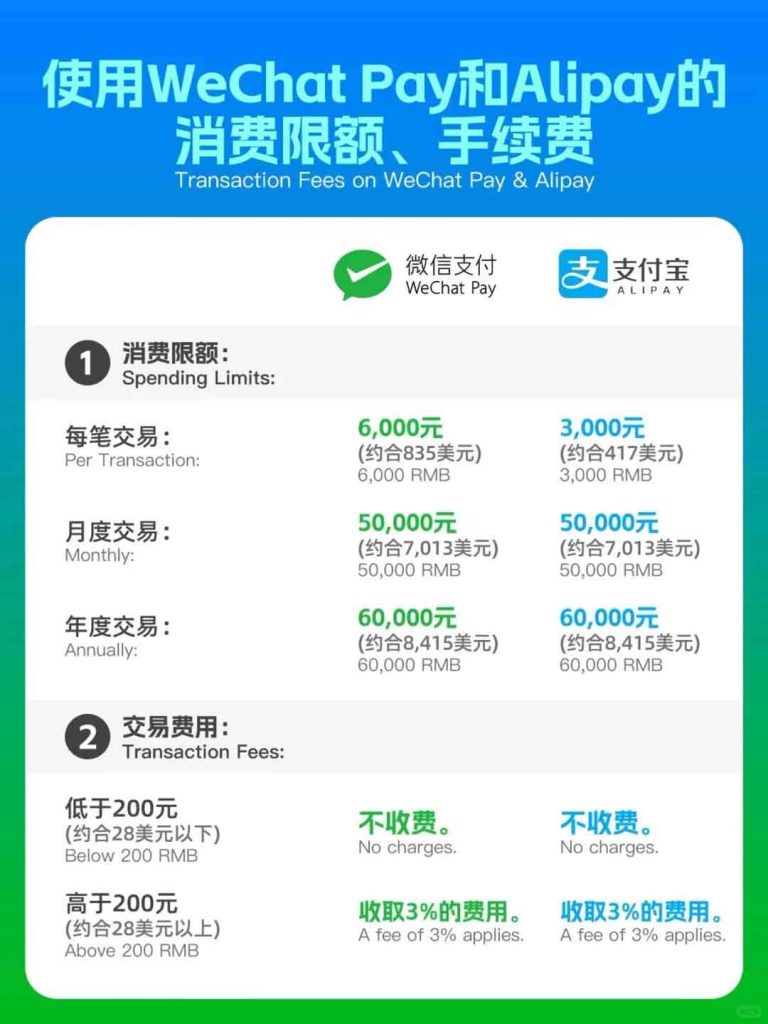
5、Will overseas credit cards incur fees?
Current general fee rules are as follows:
| Single transaction amount | Platform service fee |
| RMB 200 or below | Usually no service fee |
| Over RMB 200 | Platform may charge approximately 3% service fee |
Additionally, your credit card issuing bank may also charge overseas transaction or foreign currency transaction fees. Please refer to your issuing bank’s announcements for actual fee standards.
If you hold an overseas travel high-reward credit card, you can also check in advance whether it offers cross-border spending rewards to reduce overall payment costs.
6、Four payment details most easily overlooked during travel in China
① It is recommended to prepare a small amount of RMB cash
Although electronic payments are already very widespread, in remote areas, small markets, roadside stalls, or places with weak mobile signals, cash payment may still be required.
Additionally, some small merchants only provide personal payment QR codes and may not accept overseas credit card payments.
It is recommended to prepare about 600–1000 RMB per person as backup.
② Overseas credit cards usually cannot be used for personal transfers
After binding an overseas credit card, it can generally be used for merchant purchases in most cases, but usually cannot be used for:
- WeChat or Alipay friend transfers
- Sending red packets
- AA splitting meal costs
- Scanning personal payment QR codes for payment (in some cases)
If you encounter the above situations, you can switch to cash or ask the merchant to provide a merchant payment QR code.
③ Large transactions may trigger bank security verification
If the single transaction amount is high, for example:
- Chartered car fees
- High-priced goods
- Large shopping
Some overseas banks may activate security verification mechanisms, causing the transaction to temporarily fail.
It is recommended to notify your card-issuing bank before departure that you will be traveling to China, which can reduce the risk of being misjudged as an abnormal transaction.
④ Remote areas may have no mobile network
In some areas of Xinjiang, the Qinghai-Gansu Grand Loop, and Tibet, for example:
- Some desert highways
- Deep grasslands
- Remote highland areas
- Some mountainous regions
Mobile signals may be weak or even temporarily without network.
It is recommended to download offline maps in advance and prepare a small amount of cash to make your journey more worry-free.
Final note
Nowadays, traveling to China without a mainland bank card is no longer an obstacle.
As long as you bind Alipay or WeChat Pay in advance, prepare a credit card that supports overseas transactions, and carry a small amount of RMB cash, most travel scenarios can be easily handled.
If you are planning a trip to China Xinjiang, Qinghai-Gansu Grand Loop, Gannan, Zhangjiajie, or other places in China, in addition to payment issues, if you have any questions about chartered car routes, accommodation arrangements, scenic spot tickets, itinerary planning, etc., feel free to contact us.
We have long served travelers from Hong Kong, Taiwan, Singapore, Malaysia, and overseas Chinese, providing 2–6 person pure play chartered car customized travel, from pre-trip consultation, route planning, accommodation arrangements to travel advice, we can help you prepare everything at once, so that your first time coming to Northwest China can also enjoy the journey easily and with peace of mind.
Elephant Travel | Specializing in private customized travel in China for Hong Kong, Macao, Taiwan, and overseas Chinese
2–6 person independent chartered car | pure play no shopping | one-on-one itinerary planning
Common Questions about China Travel Payments (FAQ)

Scan to add WeChat