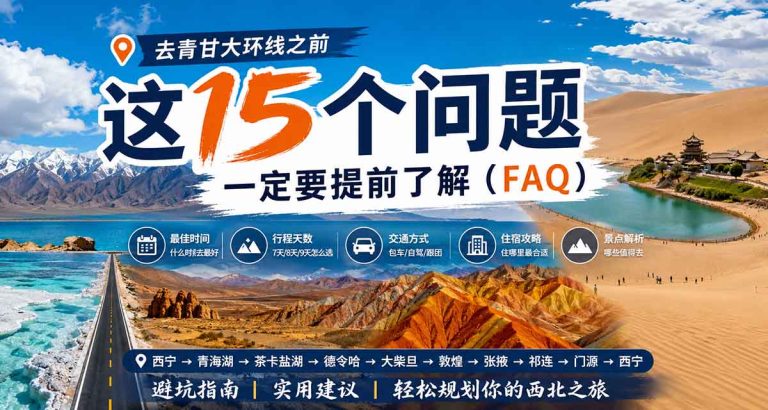
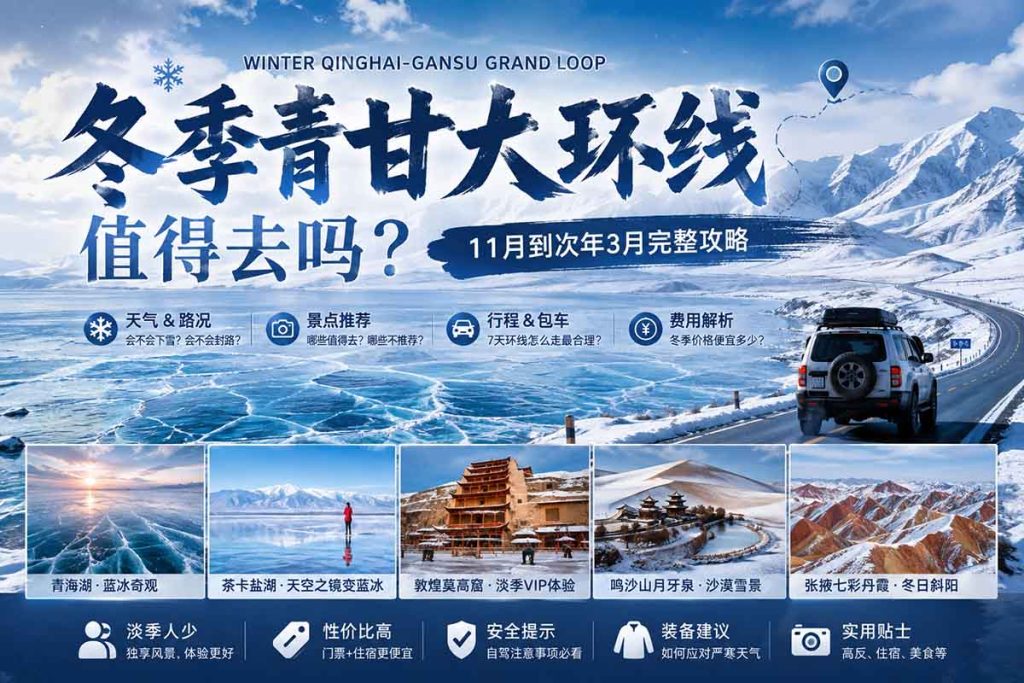
When many people hear about the Gansu-Qinghai Grand Loop—also known as the Northwest Grand Loop or the Gansu-Qinghai Grand Loop—their first thought is summer.
The rapeseed flowers along the shores of Qinghai Lake, the reflections at Chaka Salt Lake, the grasslands of the Qilian Mountains, the deep blue sky, and the tourists and self-driven vehicles along the way all come together to form what most people envision as the “Classic Qinghai-Gansu Grand Loop.”
But if you plan your trip for November through March of the following year, you’ll see a completely different Northwest.
The rapeseed flowers have faded, and the grasslands no longer wear their summer green, but in their place are snow-capped mountains, frozen lakes, Danxia landscapes after a snowfall, the vast Gobi, and the quiet desert. The number of tourists has noticeably decreased, and many places have regained a rare sense of tranquility.
Therefore, the Winter Qinggan Grand Loop is still worth visiting, but it’s not simply the same route as the summer one, just in a different season.
Winter travel requires choosing different attractions and adjusting itineraries; it’s also better suited to private car rentals or customized trips rather than simply following the same group tour routes used in the summer.
If you love snowy landscapes and the desolate, vast scenery of Northwest China, and want to avoid the summer crowds, then Qinghai and Gansu from November through March of the following year might actually offer you a completely different travel experience.
1: Is it actually possible to hike the Qinghai-Gansu Grand Loop in winter?
Sure.
The Qinghai-Gansu Grand Loop does not cease operations entirely just because winter has arrived. Most major cities, major transportation routes, and famous tourist attractions in Qinghai and Gansu remain accessible to travelers.
It’s important to note that travel conditions in winter are different from those in summer.
The biggest advantages of visiting Qingdao and Gansu in the summer are the relatively stable weather, long daylight hours, and consistent access to scenic areas, as well as the wide range of group tour and carpooling options offered by travel agencies on fixed itineraries.
Once winter sets in, the number of visitors decreases, and some scenic areas and lodging facilities switch to off-season operating modes; certain high-altitude road sections may also be affected by snowfall, icing, and changing weather conditions.
Therefore, the most important consideration regarding winter blue-backed croaker fishing is not “whether or not to go,” but rather:
How should I get there?
If you were to simply replicate the classic Qinggan Grand Loop from July and August exactly as it is in December, the travel experience might not be ideal.
In fact, flexibly adjusting your itinerary based on the weather, road conditions, and the attractions’ operating hours is often the best way to travel in winter.
2: Why Is Qinggan Still Worth Visiting in Winter?
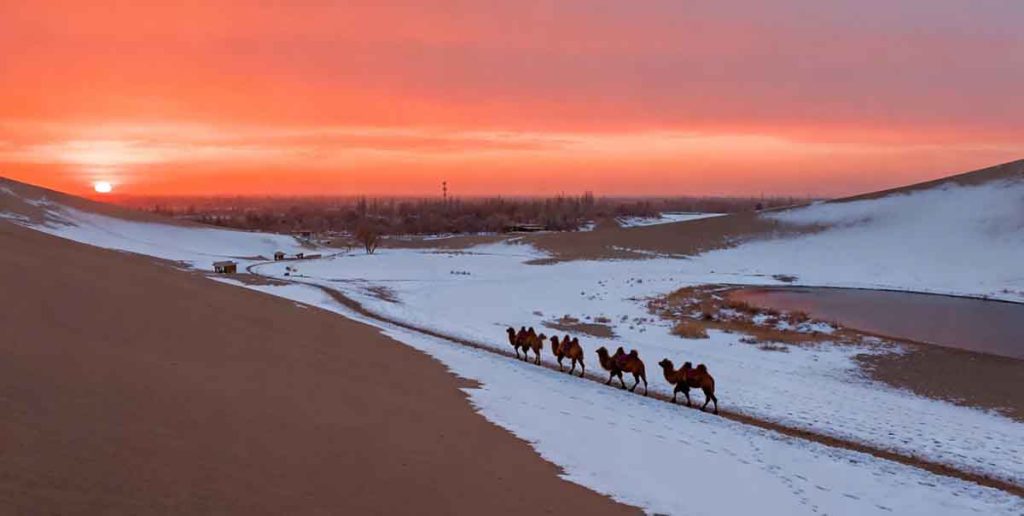
The biggest change in Qinggan during winter isn’t that “the scenery disappears,” but rather that it takes on a different form.
1. Snow-capped mountains and ice and snow make the Northwest seem even more vast.
In summer, Qinggan is characterized by blue skies, lakes, grasslands, and seas of flowers.
In winter, it's more like:
- Snow-Capped Mountains
- Frozen Lake
- Snowfield
- Gobi Desert
- Desert
- Danxia After a Snowfall
The vast expanses of white combined with the desolate Gobi Desert make the entire Northwest seem even more vast.
If you enjoy photography, winter actually offers the chance to take photos that are completely different from those taken in summer.
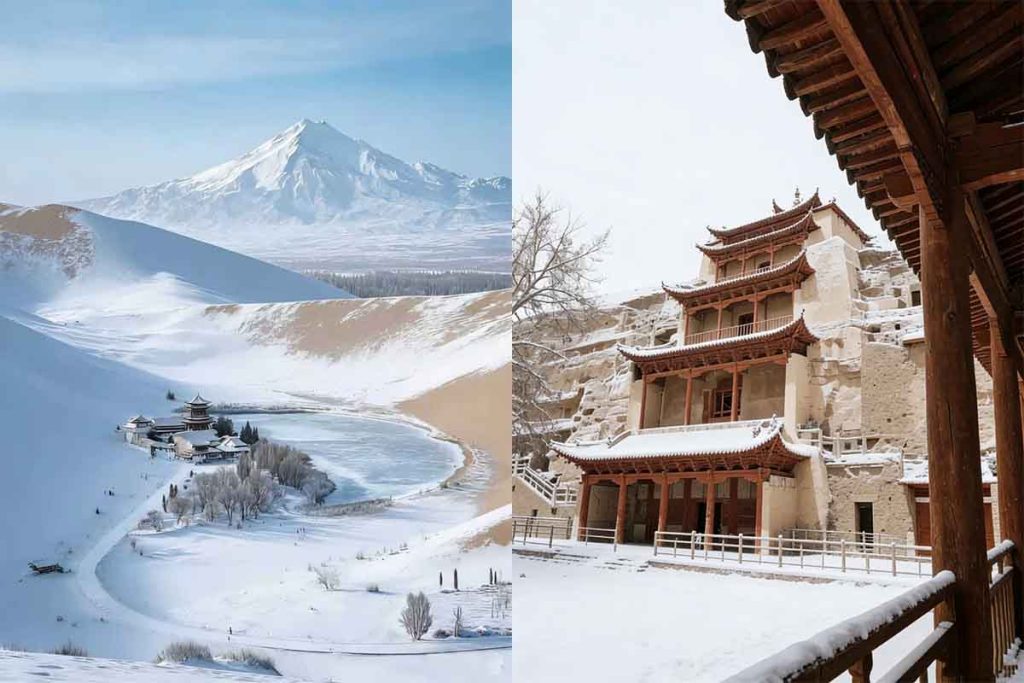
2. There has been a noticeable decline in the number of tourists.
This is a very real advantage of winter yellow croaker.
Summer is the peak tourist season for the Qinghai-Gansu Grand Loop, and popular attractions such as Qinghai Lake, Chaka Salt Lake, Emerald Lake, and Mingsha Mountain all attract large numbers of visitors.
The number of tourists has dropped significantly during the winter.
Some attractions may become:
The scenery is still there, but there are far fewer tourists.
For tourists who don't like waiting in line or taking photos in crowds, this is a rare treat.
3. Winter is a better time for private travel
There are a large number of group tour and carpooling options available during the summer, so many tourists opt for lower-priced fixed itineraries.
With the decline in winter tourism, traditional group tour packages have become significantly less common, while private car rentals and customized trips have instead become more suitable options.
The biggest advantage of private travel is flexibility.
If the weather is nice one day, you can add another attraction to your itinerary; if it snows or the roads are icy, you can adjust your plans without having to wait along with a group of dozens of people.
This is especially important for winter yellow croaker.
3: What is the difference between November, December, January, February, and March?
Although the period from November through March can be considered the winter tourist season, the weather and scenery vary from month to month.
November: Early winter—ideal for those looking to avoid the peak season
November marks the transition from fall to winter.
Compared to December through February, temperatures are generally not as low; in some areas, you can still see the colors left over from fall, while snow may already have fallen in high-altitude regions.
One advantage of this month is:
The winter atmosphere is starting to set in, but we haven't reached the coldest part of the season yet.
If you're not particularly interested in the snow and ice of midwinter but want to avoid the summer crowds, November is a good time to consider.
However, weather conditions in November can vary significantly from year to year, so the specific route will still need to be adjusted based on the weather conditions that year.
December: Winter is truly here
After December, Qinghai and Gansu begin to clearly enter winter.
Temperatures have dropped significantly at Qinghai Lake, Chaka, Dachaidam, and in some high-altitude areas, increasing the likelihood of snowfall and icy conditions.
The most distinctive feature of traveling at this time is:
Winter scenery is becoming an integral part of the travel experience itself.
Snow-capped mountains, ice fields, the Gobi Desert, and other deserts come together to create a landscape in the Northwest that is completely different from that of summer.
If your goal is to see the Northwest in winter, then December would be a better time to start your trip.
January through February: Midwinter Snow Scenes
January through February is usually the coldest part of winter.
At this time, it’s important to pay closer attention to the weather, road conditions, and whether attractions are open.
However, from a scenic perspective, late winter is also a very distinctive time of year.
When it snows, the Danxia landforms, snow-capped mountains, the Gobi Desert, and the frozen lakes all take on a very distinct winter atmosphere.
It’s important to note that it doesn’t snow every day, nor do all tourist attractions offer ideal snowy scenery at the same time.
Therefore, when traveling in winter, it’s best not to make a single snowfall the sole focus of your entire trip; instead, you should allow for some flexibility in your itinerary.
March: Late winter; the change of seasons begins
Since the beginning of March, temperatures have gradually risen in some areas.
However, Qinghai-Gansu covers a very large area, and there are significant climatic differences between regions; high-altitude areas can still be very cold.
The most notable feature of March is:
The winter scenery is still visible, but it has already begun to give way to spring.
If you want to avoid the coldest part of midwinter but still see some snowy and icy scenery, you might want to consider visiting in March.
4: What are some great places to visit in Qinggan during the winter?
Not all tourist attractions in Qinghai and Gansu are closed during the winter; many classic sites are still worth visiting, though the scenery shifts from the summer’s sea of flowers and grasslands to ice, snow, snow-capped mountains, and the more desolate landscapes of the Northwest.
Qinghai Lake
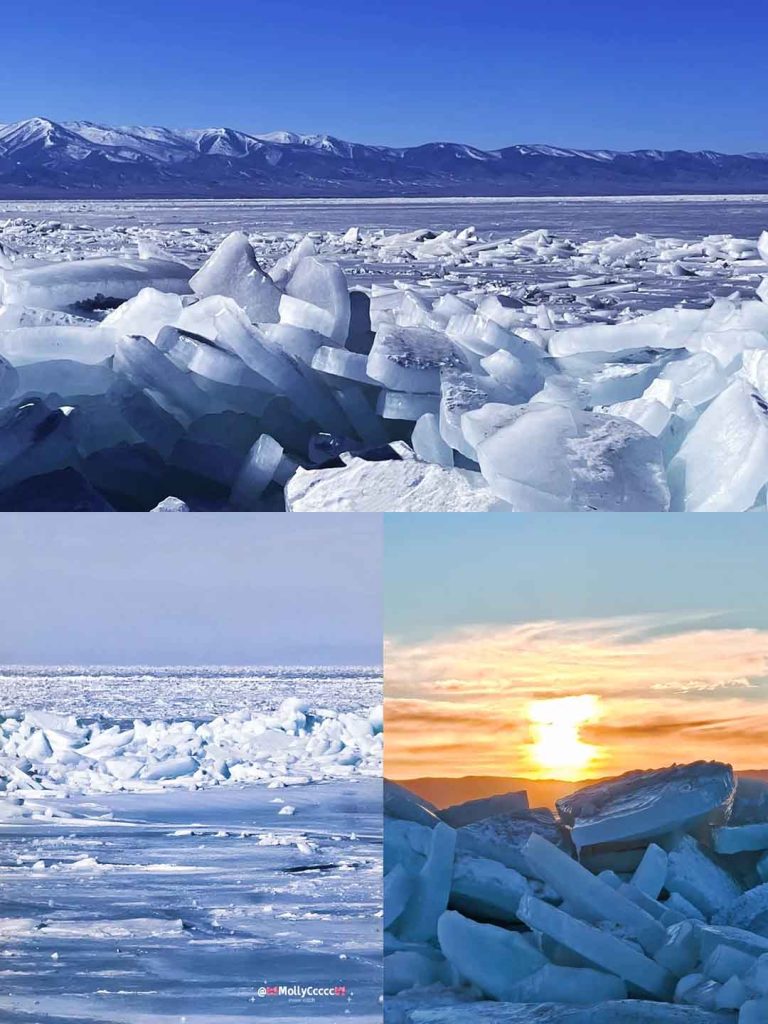
In winter, Qinghai Lake is devoid of the rapeseed flowers and tourists found in summer; some areas may freeze over, and when weather conditions are right, visitors can see the frozen lake, snow-capped mountains, and the vast lakeshore. The extent of freezing varies from year to year.
Chaka Salt Lake
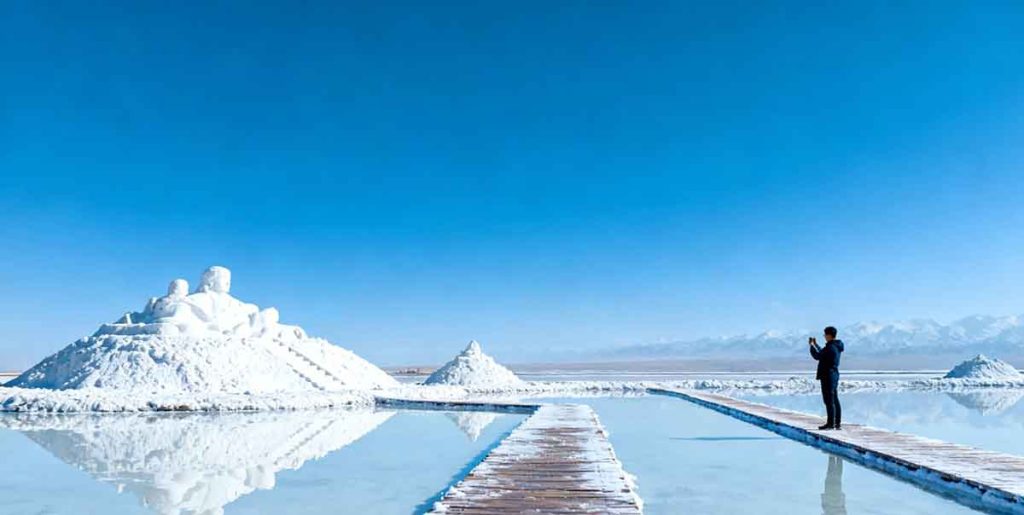
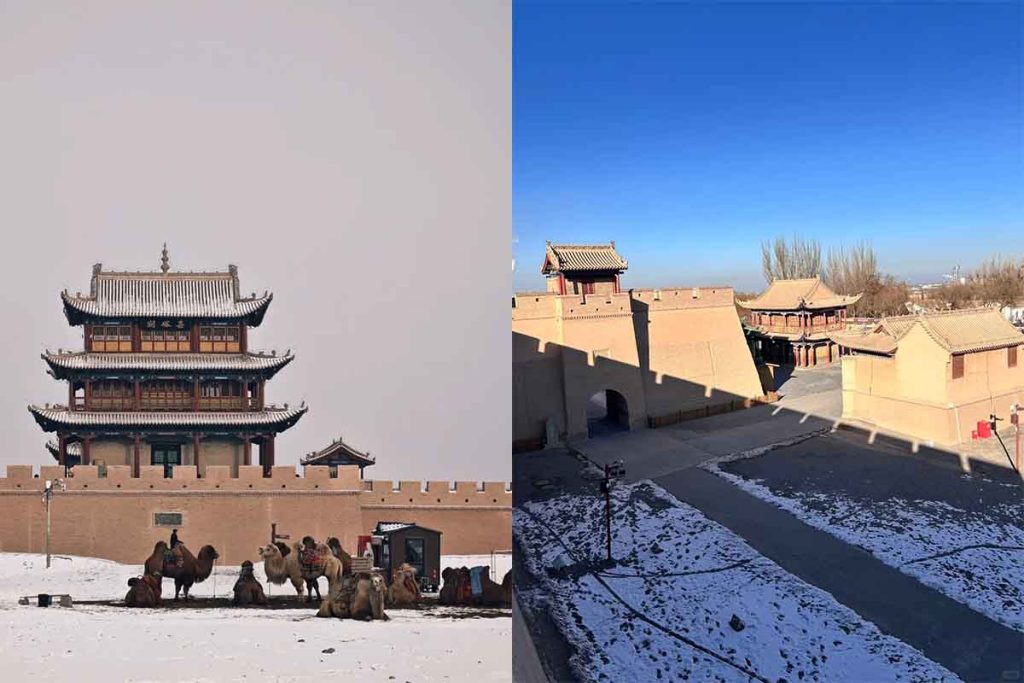
TeKa in winter is completely different from the “Mirror of the Sky” seen in summer. Parts of the lake’s surface may freeze, creating a unique winter landscape with the salt lake, ice and snow, and distant mountains. Whether you’ll be able to see the ideal frozen surface depends on the weather conditions that year.
Emerald Lake
Jade Lake is still worth visiting in winter, though the condition and color of the lake will be affected by the temperature. If the weather and road conditions are right, it’s still worth a visit.
Yadan on Water
In winter, the Yadan landforms on the water appear even quieter and more desolate. When it snows or freezes, the Yadan landforms blend with the snow and ice, creating a landscape completely different from that of summer. However, since this area is quite remote, special attention must be paid to weather and road conditions during the winter.
Qarhan Salt Lake
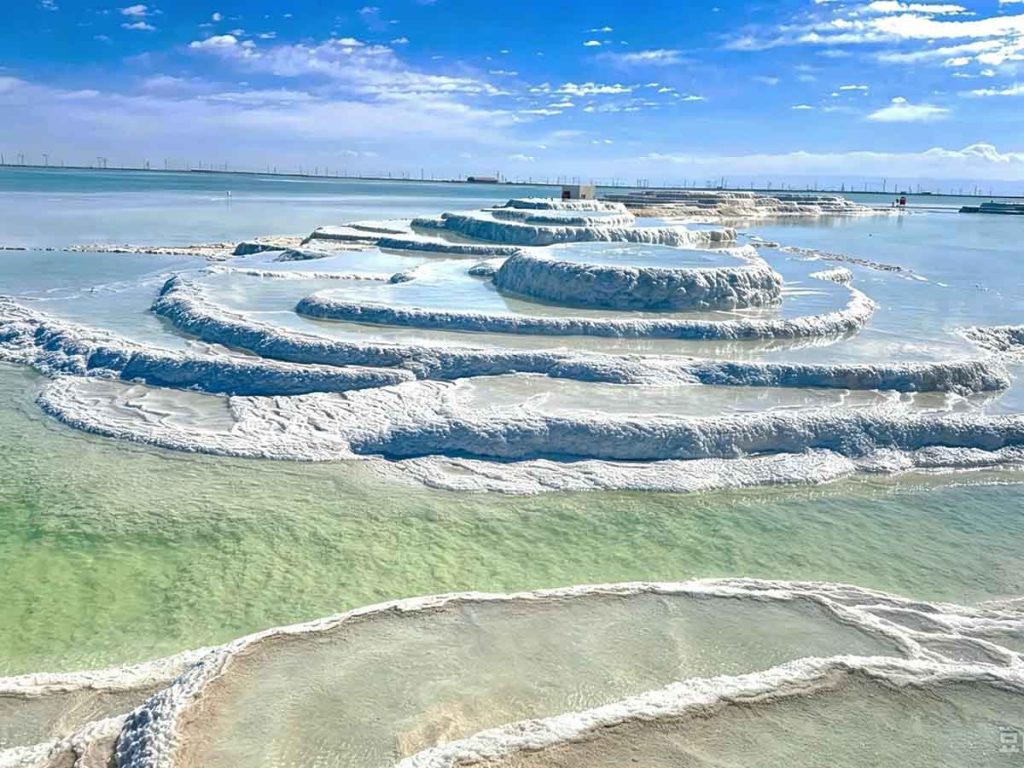
The scenic area remains open as usual during winter, with few visitors and discounted off-season admission.Due to the high salinity of the lake water, it does not freeze completely. A thin layer of snow covers the salt flats, revealing sparkling salt crystals, and the vast, desolate salt bridge stretches for miles, offering a view of the salt lake’s blue-and-white-streaked wilderness landscape. The condition of the lake surface varies from year to year depending on temperatures. Winters are windy and cold, so be sure to wear warm clothing and take precautions against slipping. Ctrip
Dunhuang
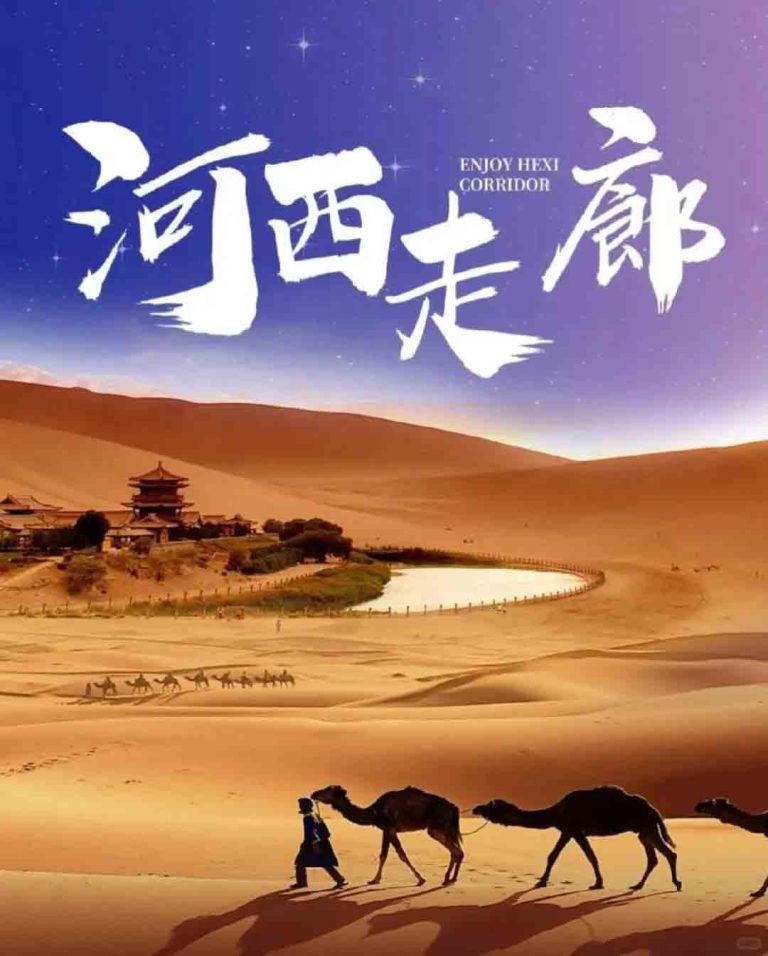
Dunhuang is a stop well worth including on a winter tour of Qinghai and Gansu.You can plan visits to the Mogao Caves, the Singing Sand Mountain and Crescent Lake, and the Yadan landforms. In particular, since there are fewer tourists in winter, it’s much easier to secure tickets for the Mogao Caves (which are very hard to get during summer vacation), and the desert and Gobi are much quieter. If it snows, the Singing Sand Mountain will also present a truly unique sight.
Zhangye's Colorful Danxia Landforms
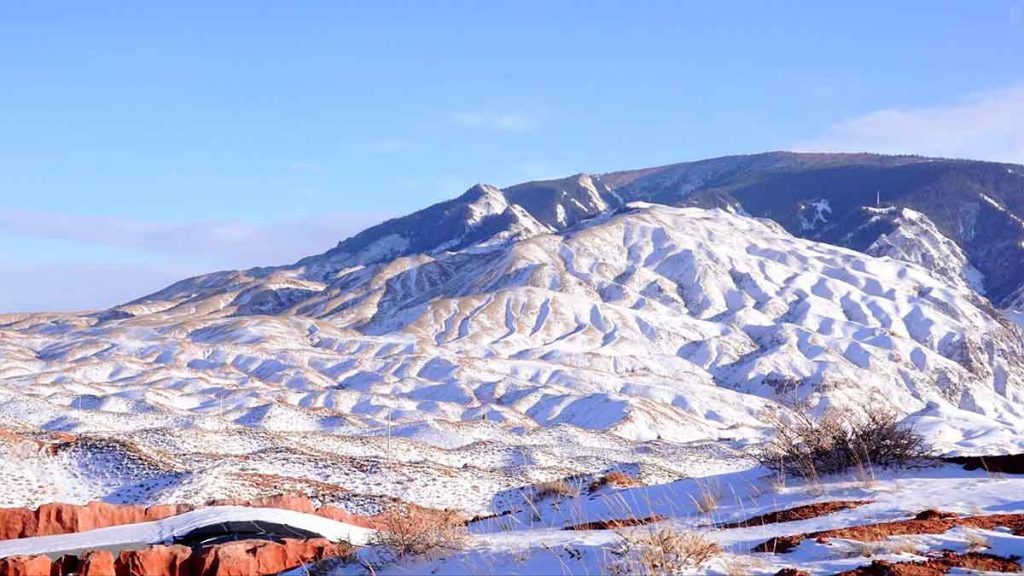
It’s still worth visiting in winter. Although the colors aren’t as vivid as they are in summer, the layers of the Danxia mountains are still clearly visible in the low-angle sunlight. If it snows, the red, yellow, and gray mountains create a striking contrast with the white snow.
What areas need to be adjusted during the winter?
Winter travel in Qinghai and Gansu isn't simply a matter of "which attractions to avoid," but rather requires re-planning based on the season.
Heimahe River, Qinghai Lake
Winter is the off-season in Heimahe, and some tourist facilities are closed; therefore, it is not recommended to use Heimahe as an overnight stop on the summer itinerary.
Menyuan
Menyuan’s most distinctive seasonal feature is the sea of rapeseed flowers in summer; this sight isn’t available in winter, so unless you’re particularly eager to see the winter snow scenery, you might want to lower its priority on your itinerary.
Qilian
It’s not true that you “can’t visit” the Qilian Mountains in winter. Although the grasslands aren’t as green as they are in summer, the snow-capped mountains, snowfields, and winter grasslands still have their own unique charm. If the weather and road conditions are favorable, you can plan your trip around the overall itinerary.
5: Does it snow in Qinggan during the winter?
Yes.
Some areas of Qinghai and Gansu experience snowfall in the winter, especially in high-altitude regions and mountainous areas.
However, there is one very important point to note:
It doesn't snow every day in Qinggan during the winter.
It's possible that during a 7-day trip, you'll only experience snow on one or two days, or it's possible the entire trip will be sunny.
So if you really love snowy scenery, it’s best not to plan an itinerary that requires you to see snow every day.
A more reasonable approach would be:
Focus on winter scenery as the main theme, and select the areas best suited for photographing snowy landscapes based on real-time weather conditions. We recommend contacting a local travel agency before departure to check the weather forecast.
This is also where custom tailoring really shines during the winter.
6: Will the Qinggan Road be closed in winter?
It's possible.
This is also one of the biggest differences between winter and summer travel.
In the event of heavy snow, high winds, or icy roads, temporary traffic restrictions may be implemented on certain high-altitude sections, mountain roads, or roads leading to remote scenic areas. This may significantly increase your actual driving time.
Therefore, it’s best not to plan your winter itinerary too tightly, and avoid scheduling too many hours of driving each day.
7: Just how cold is Qinggan in winter?
This is also the question that most concerns many tourists visiting the Northwest for the first time.
In Qinghai and Gansu, there is a significant temperature difference between day and night during the winter, and this varies greatly depending on the region, elevation, and weather conditions.
The weather conditions in urban areas and high-altitude scenic spots can be completely different.
On sunny days, when the sun is out at noon, it may feel relatively comfortable; however, after sunset, the temperature drops rapidly.
In particular, at Qinghai Lake, Dachaidam, and some high-altitude areas, temperatures may drop very low in the early morning and evening.
Therefore, you shouldn’t just look at a single number on the weather forecast.(In Qinghai and Gansu, daytime temperatures in winter are generally around 0–4 degrees, while mornings and evenings drop to around minus 10 degrees. Although the temperature difference is significant, it’s not actually that cold. Just make sure to pack a hat, scarf, and gloves, along with a down jacket, thermal underwear, and fleece-lined pants.)
If you plan to spend a long time taking photos outdoors, it’s especially important to keep your hands and feet warm.
8: Is it safe to drive yourself in the winter?
You can drive yourself, but be sure to exercise caution.
If you have no experience driving on icy or snowy roads, we do not recommend taking a long road trip.
Winter Driving Risks: Snowfall, icy roads, black ice, high winds, low visibility, night driving, temporary traffic restrictions, and sudden weather changes at high altitudes.
It is recommended that vehicles be equipped with snow tires, traction aids, and emergency supplies.
For foreign tourists visiting for the first time, driving themselves requires juggling the route, weather, accommodations, and various unexpected situations, which can be quite a burden.
If you're unfamiliar with local road conditions, it's safer to opt for a private car hired from a local driver.
9: Why is Qinggan a better choice for private car rentals in winter?
This may be the biggest difference between winter and summer yellow croaker.
With large numbers of tourists during the summer, there is a plentiful supply of:
- Group Buying
- Carpooling
- 7-Day Fixed-Itinerary Tour
- 8-Day Fixed-Itinerary Tour
With the decline in the number of winter tourists, there has been a noticeable decrease in the number of fixed group tour packages.
But that doesn't mean there are no tourists in the winter.
On the contrary, tourists who are truly willing to visit Qinghai and Gansu in the winter tend to have a clearer idea of their travel needs.
For example:
“I just want to see the Danxia landscape after it snows.”
"I'd like to go to Qinghai Lake to see the frozen lake in winter."
“I don’t want to drive many kilometers every day.”
"If it snows, I hope we can adjust our plans."
This type of demand is naturally better suited to custom solutions.
The Benefits of Hiring a Private Car
First, the itinerary can be adjusted.
If the weather is bad one day, you can adjust your itinerary accordingly.
Second, there’s no need to cater to unfamiliar tourists.
Small groups of 2–6 people can travel at their own pace.
Third, it can reduce unnecessary long-distance driving.
Since daylight hours are shorter in winter, it's even more important to plan your daily schedule carefully.
Fourth, it's better suited for photography.
If the weather and lighting are particularly good at a certain location, you can extend your stay there as appropriate, rather than having to leave according to the group’s schedule.
10: Is it still possible to hike the Qinghai-Gansu Grand Loop in winter for 7 days?
It's possible, but I wouldn't recommend simply copying the summer loop itinerary.
When planning for winter, it is important to take the following factors into account: weather, road conditions, daylight hours, attraction operating hours, and the scenic appeal of winter landscapes.
Popular summer attractions may not offer the best experience in winter; if it snows, prioritize spending your time at spots where the snowy scenery is particularly stunning.
During your 7-day winter trip, don’t feel pressured to visit as many attractions as possible; instead, focus on key destinations that are particularly stunning in winter and plan your itinerary flexibly.
If circumstances allow, an 8- to 10-day trip will be more relaxed than a packed 7-day itinerary.
11: How much cheaper are winter tours to Qingdao and Gansu?
Winter is the off-season for tourism, so prices at some hotels, tourist attractions, and for certain tourism services are typically lower than during the summer peak season.
When it comes to accommodations, some hotels offer significant discounts during the off-season.
Some scenic spots also offer off-season ticket prices that differ from those during peak season, and they’re much lower.
However:
Don't simply assume that winter travel always costs half as much as summer travel.
Since private car rentals are a customized service, the vehicle, driver, itinerary, duration, and accommodation standards will all affect the final price.
Furthermore, even though there are fewer tourists in winter, when it comes to private car rentals, “the cheaper, the better” isn’t necessarily the case.
When it comes to long-distance travel in winter, the condition of the vehicle, the driver’s experience, and the route planning are all integral to the quality of the trip.
12: What kind of travelers is a winter trip to Qinggan best suited for?
If you fall into any of the following categories, winter yellow croaker is a great choice for you:
✅ I love snowy landscapes
If you’re drawn to snow-capped mountains, frozen lakes, and deserts blanketed in snow—and aren’t particularly attached to summer’s seas of flowers or lush green meadows—then the desolate, icy landscapes of Northwest China in winter will be more to your liking.
✅ I hate crowds
If you want to avoid the summer crowds and enjoy a quiet, immersive tour of Northwest China, winter—when there are fewer tourists—offers a much better experience.
✅ Enjoys photography
The unique winter light, combined with the interplay of ice, snow, and the Gobi salt lake, creates images that are completely different in style from those taken in summer.
✅ Prefers traveling in small groups
Small-group private charters for 2–6 people—ideal for those who prefer not to join a group with strangers—are particularly well-suited for winter travel.
✅ Flexible itinerary
If you don't want a rigid, fixed daily itinerary and are open to adjusting your route flexibly based on weather changes, you'll have a better travel experience.
13: Is the Winter Qinghai-Gansu Grand Loop worth visiting?
It's worth it.
In winter, Qinggan lacks the rapeseed flowers and green grasslands of summer, but it offers snow-capped mountains, frozen lakes, Danxia landforms after a snowfall, the Gobi Desert, and the even quieter vastness of the Northwest.
When traveling in winter, it’s best to adjust your itinerary flexibly based on the weather, road conditions, and the situation at tourist attractions; it’s also ideal for private chartered vehicles and small, customized group tours.
We are a local travel agency in Qinghai that offers private car tours and customized travel packages for groups of 2–6 people. If you’re planning to visit Qinghai or Gansu between November and March of the following year, please let us know your travel dates and the number of people in your group, and we’ll design a suitable itinerary for you based on winter road conditions and weather.
Contact us to customize your winter trip to Qingdao and Gansu.
Elephant Travel | Specializing in Customized Private Tours in China for
2–6 People with Exclusive Chartered Vehicles | Sightseeing-Only, No Shopping | One-on-One Itinerary Planning

Scan the QR code to add me on WeChat